Your carpenter’s quote will most likely have plywood for the wardrobe, then plywood for the kitchen and finally MDF for the TV unit. Why two boards? Is the less expensive one sneaking in? It’s fair to question. The confusion around MDF vs plywood is common because most people can’t tell the difference once the boards are covered in laminate or painted.
The real difference becomes apparent years later, particularly after surviving a couple of Bangalore monsoons. Will the cabinet doors still close properly? Will the shelves hold their weight? This guide explains the differences between the boards, their durability, price and best uses in home interiors.
Quick Summary: MDF vs Plywood
- Best for Strength: Plywood is generally stronger and better suited for load-bearing furniture such as beds, wardrobes and cabinets.
- Best for Decorative Designs: MDF is ideal for painted shutters, CNC designs, wall panels and smooth decorative finishes.
- Moisture Resistance: BWP plywood is generally preferred for moisture-prone areas, while standard MDF can swell when exposed to water.
- Kitchen Cabinets: Choose suitable-grade plywood for cabinet structures, especially near sinks and plumbing.
- Wardrobes: Use plywood for frames and shelves, while MDF can be used for decorative shutters.
- TV Units & Wall Panels: MDF works well for decorative surfaces, while plywood is preferable for load-bearing structures.
- Price Comparison: MDF is generally more affordable than plywood, but prices depend on thickness, brand and material grade.
- Final Recommendation: Use plywood where strength and moisture resistance matter, and MDF where appearance, detailing and budget are priorities.
MDF vs Plywood: Which Is Better?
Plywood is generally better for kitchen cabinets, wardrobe frames and furniture that needs strength and reliable screw holding. MDF works well for painted shutters, decorative panels and CNC designs in dry interiors. The better choice depends on moisture exposure, load, surface finish and budget.
Most well-planned homes can use both materials in different areas. Instead of choosing one for the entire house, it makes more sense to match the board to its purpose.
What Is MDF?
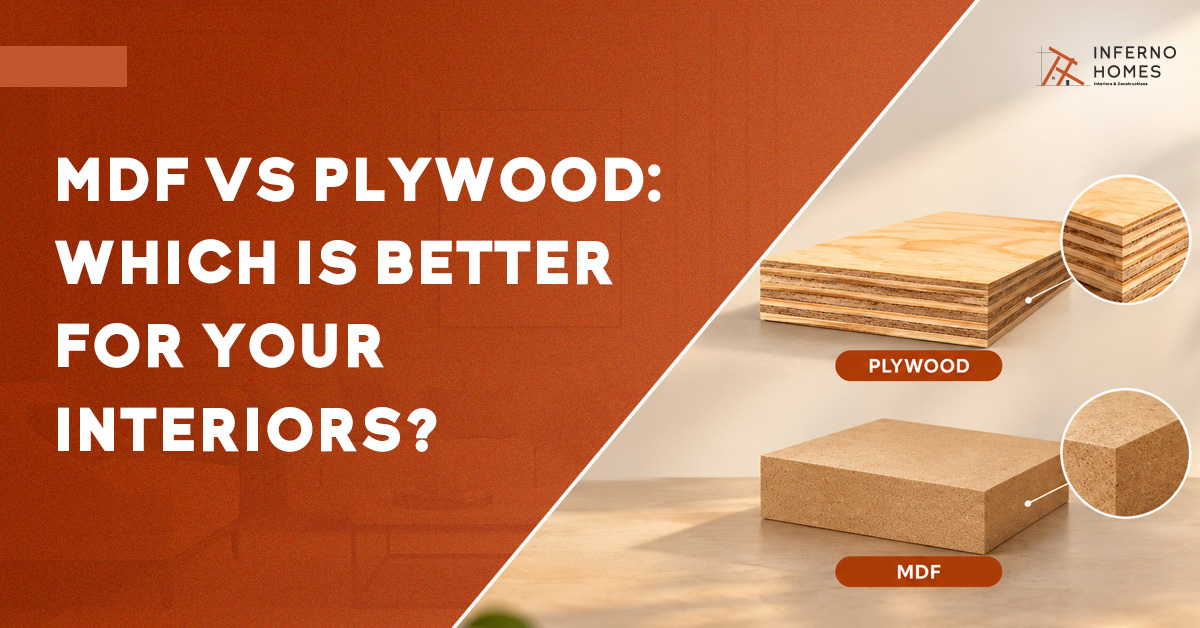
MDF stands for Medium Density Fibreboard. It is an engineered wood product made by combining fine wood fibres with resin and wax before pressing them into dense sheets under heat and pressure.
Since there are no visible knots or wood grains to contend with, paint can be applied smoothly, and a router can be used to create curves and decorative patterns.
MDF isn’t as strong as structural-grade plywood in many furniture applications. Standard MDF can swell when exposed to moisture and may sag under heavy loads without proper support. However, it provides a smooth finish and can last for years when kept dry and used appropriately.
Not all MDF boards are the same. Standard MDF works best in dry interiors, while moisture-resistant MDF offers improved performance in humid conditions. Before purchasing, check the manufacturer’s specifications and recommended applications. Moisture-resistant MDF should not automatically be treated as waterproof.
What Is Plywood?
Plywood is made by gluing thin layers of wood veneer together, with the grain of adjacent layers generally running in different directions. This cross-layering improves strength and dimensional stability.
Quality plywood generally offers better screw-holding strength and resistance to bending than standard MDF. However, its performance depends on the wood species, thickness, grade and manufacturing quality.
Plywood grades are particularly important:
- MR Plywood (Moisture Resistant): Suitable for dry indoor furniture such as wardrobes, shelves and bedroom cabinets.
- BWR Plywood (Boiling Water Resistant): Offers greater water resistance and is suitable for furniture exposed to occasional moisture when properly installed.
- BWP Plywood (Boiling Waterproof): Designed for more demanding wet conditions. Plywood certified to IS 710 is commonly preferred for moisture-prone kitchen cabinetry.
These grades should not be confused with a guarantee against damage from persistent leaks or poor installation. Proper finishing and edge sealing still matter.
The downsides? Plywood generally costs more than MDF, and its surface may require additional preparation for certain painted finishes.
What Is the Difference Between MDF and Plywood?
People sometimes talk about “MDF plywood” as if it’s one product. It isn’t. The main MDF vs plywood difference comes from their composition, strength, moisture performance, finish and cost.
|
Factor |
MDF | Plywood |
|
Made from |
Wood fibres, resin and wax | Thin cross-layered wood veneers |
| Strength | Suitable for lighter applications |
Generally stronger for load-bearing furniture |
|
Screw holding |
More sensitive to repeated fastening | Generally better screw retention |
| Moisture resistance | Standard MDF swells when wet |
Depends on grade; BWP offers greater resistance |
|
Surface finish |
Smooth and paint-ready | Suitable for laminate and veneer finishes |
| Detailing | Good for CNC cutting and carving |
Can be machined but requires different finishing |
|
Price |
Generally lower |
Generally higher |
| Best for | Decorative panels, shutters and detailing |
Wardrobe frames, kitchen cabinets and beds |
In simple terms: Choose plywood when strength and moisture resistance are priorities. Choose MDF when a smooth painted finish, decorative detailing and a lower material cost matter more.
Where Should You Use MDF or Plywood in Your Home?
1. Wardrobe
For the wardrobe, a combination of both materials can work well. Plywood is generally preferred for the carcass and shelves because they must support sarees, blankets and all those things you promised to get “sorted” last year.
Around 18–19mm plywood is commonly considered for wardrobe structures, although the final thickness should depend on shelf spans, loads and the cabinet design. Shutters may use 18mm MDF, particularly when you want a painted or CNC-cut finish. A plywood frame with MDF shutters can help balance durability, appearance and cost.
This combination is worth discussing with professional wardrobe designers when planning your storage.
For more inspiration, explore our guide to wardrobe designs for every home.
2. Kitchen
The kitchen is tough on boards. Spills, steam, cleaning and occasional leaks under the sink all put pressure on the base units.
When comparing MDF vs plywood for kitchen cabinets, plywood is generally the safer choice for supporting structures and moisture-prone areas.
Choose suitable-grade plywood, such as IS 710-certified BWP plywood, for cabinets exposed to a higher risk of water contact. Standard MDF is less suitable around sinks and plumbing. Moisture-resistant MDF may work for selected shutters where the manufacturer’s specifications permit its use.
A good board alone won’t prevent water damage. Edges, joints, sink cut-outs and plumbing connections must also be properly finished and maintained. If you’re planning a modular kitchen, our kitchen interior designers can help you explore suitable materials and layouts.
Looking to save somewhere else? We have come up with simple kitchen design ideas that help maximize space in small homes.
3. Bedroom
More than most furniture, a bed frame leads a hard life. It supports two adults, a mattress and perhaps a storage compartment stuffed with winter quilts throughout the year.
When comparing MDF board vs plywood for bedroom furniture, plywood is generally the better option for bed frames and load-bearing storage structures. MDF can be used for dressing-table back panels, decorative drawer fronts and other parts where appearance matters more than structural strength.
For heavy beds and storage units, proper joinery, supports and material thickness are just as important as the board itself.
4. TV Unit
A TV unit is usually placed in a dry room and may hold a screen, set-top box and decorative items. MDF is a practical material for painted surfaces, fluted panels and LED grooves.
However, for wall-mounted units, the supporting structure and fixing points must be designed for the expected load. Plywood is often preferred for load-bearing shelves and cabinet structures, while MDF works well for decorative fronts and exposed finishes.
Most modern TV unit designs can combine both materials, balancing appearance, durability and cost.
5. Wall Panelling
When comparing MDF wood vs plywood for decorative wall panelling, MDF often has the upper hand. Its uniform surface can be painted and routed into grooves, flutes and patterns. It works particularly well for dry interior walls where the panel is primarily decorative.
However, avoid fixing standard MDF directly onto damp surfaces. A plywood backing alone will not solve an existing moisture problem. Identify and repair the source of dampness before installing any wood-based wall panel.
Proper edge sealing and ventilation can also help the finished panels last longer.
6. Decorative Headboard
A decorative headboard is another area where MDF can be a good choice. You can cut it using CNC machinery, upholster it, add backlighting or paint it almost any colour. The smooth surface makes decorative finishing easier.
However, large upholstered or wall-mounted headboards can be heavy. The panel thickness, backing and mounting brackets must be selected according to the design. Seal the exposed edges and use suitable fixings to secure the headboard safely.
MDF vs Plywood Price Difference in Bangalore
When it comes to the MDF vs plywood price difference, standard MDF is generally less expensive than comparable plywood, especially higher-grade BWP plywood.
However, the actual price depends on the board thickness, brand, grade and supplier. A 6mm MDF sheet cannot be fairly compared with 18mm BWP plywood, for example.
When comparing prices in Bangalore, request quotations for the same sheet dimensions and thickness. Also check whether the estimate includes laminates, edge banding, hardware, labour and installation.
That doesn’t necessarily mean a cheaper board offers better value. An MDF wardrobe base that swells after repeated exposure to moisture may cost more to replace than the initial saving.
Use plywood in load-bearing and moisture-prone areas where its properties justify the additional cost. Choose MDF for suitable decorative applications where you can save without compromising function.
What Should You Check Before Buying MDF or Plywood?
Before approving your carpenter’s quotation, check a few important details:
- Board grade: Is it standard MDF, moisture-resistant MDF, MR, BWR or BWP plywood?
- Thickness: Is the selected thickness suitable for the cabinet dimensions and expected load?
- Certification: Can the supplier provide genuine product specifications, relevant grade certification and formaldehyde-emission information?
- Finishing: Will exposed edges, joints and moisture-prone areas be properly sealed?
- Total cost: Does the quotation include finishing, hardware and installation?
For interior furniture, also consider the board’s emission classification and ventilation requirements, particularly for enclosed cabinets and bedrooms.
These checks can help you compare quotations fairly rather than making the entire decision based on the lowest price.
Final Word: Which Material Should You Choose?
So, which is better: MDF or plywood?
For kitchens, wardrobe frames and beds, strength and moisture resistance generally favour plywood. MDF is useful for decorative panels, painted shutters and detailed designs where surface finish is more important than load-bearing performance.
A well-planned home may use both materials in the right places.
The next time you receive a quotation, ask which board grade is being used, where it will be installed and why that material was chosen.
If you need guidance, our interior design services can help you explore suitable materials and practical design solutions for your home.
Contact Inferno Homes today to discuss your interior design requirements and choose materials that suit your space, budget and everyday needs.
Frequently Asked Questions
1. Does plywood last longer than MDF?
Generally, plywood offers better performance in load-bearing applications and repeated fastening. However, the lifespan of either material depends on its grade, thickness, installation, finish and moisture exposure.
2. Is MDF waterproof?
No, standard MDF is not waterproof and can swell when exposed to water. Moisture-resistant MDF provides improved humidity resistance but should not be assumed suitable for direct or continuous water contact.
3. When should you use MDF vs plywood?
Use MDF for painted shutters, CNC designs and decorative panels in dry rooms. Choose suitable-grade plywood for furniture structures, kitchen cabinets, beds and applications requiring greater strength.
4. Is MDF better than plywood for wardrobes?
Plywood is generally better for wardrobe carcasses and load-bearing shelves. MDF is suitable for decorative shutters and painted surfaces, provided the board thickness, hinges and environmental conditions are appropriate.
5. Which is better for kitchen cabinets, MDF or plywood?
Suitable-grade plywood, especially BWP plywood in moisture-prone locations, is generally preferred for kitchen cabinet structures. Standard MDF is less suitable around sinks and plumbing.
6. Which is cheaper, MDF or plywood?
Standard MDF is usually cheaper than comparable plywood. Prices vary with thickness, manufacturer, grade and supplier. Always compare boards with similar specifications.
7. What is the difference between BWR and BWP plywood?
BWR plywood offers improved water resistance for applications with occasional moisture exposure. BWP plywood meets more demanding water-resistance requirements and is commonly selected for moisture-prone cabinetry.
8. Which is better for TV units, MDF or plywood?
MDF is suitable for decorative TV panels and painted cabinet fronts. Plywood is often preferred for structural components and shelves that need to support heavier loads.